Land Clearing vs. Forestry Mulching: Which Does Your Property Need?
If you own acreage, manage rural land, or are preparing to build a new home, getting your property cleared is step one. But when you start looking into land clearing options, you’ll quickly run into two primary approaches: traditional land clearing and forestry mulching.
While both methods remove unwanted brush and trees, they work in completely different ways, serve different end goals, and carry different price tags. Choosing the wrong method can cause delays, unnecessary expenses, or unwanted soil damage.
Here is a breakdown of how both methods work and how to determine which one is right for your project.
What Is Traditional Land Clearing?
Traditional land clearing is a heavy-duty, total-site removal process. Heavy machinery—such as excavators, bulldozers, and wheel loaders—is brought in to strip away all vegetation, knock down trees, uproot stumps, and scoop away deep root balls.
How It Works:
-
Knockdown & Uprooting: Trees and dense brush are pushed over and completely removed from the soil, root ball included.
-
Debris Hauling or Burning: The resulting trees, stumps, and debris are piled, burned on-site (where permitted), or hauled away in dump trucks.
-
Rough Grading: Once the vegetation and roots are gone, excavators level and smooth the exposed dirt.
Best Used For:
-
Building Envelopes: Preparing sites for house foundations, pole barns, driveways, or concrete pads.
-
Utility Trenching: Areas where deep excavating or underground utility installation is required.
-
Complete Topsoil Re-grading: Sites where root systems would interfere with structural footings or future paving.
Pros: Complete root removal ensures no regrowth or decay beneath future structures; leaves a clean slate of dirt ready for construction.
Cons: Higher overall cost due to hauling fees and equipment demands; leaves raw soil exposed to erosion until building or seeding occurs.
What Is Forestry Mulching?
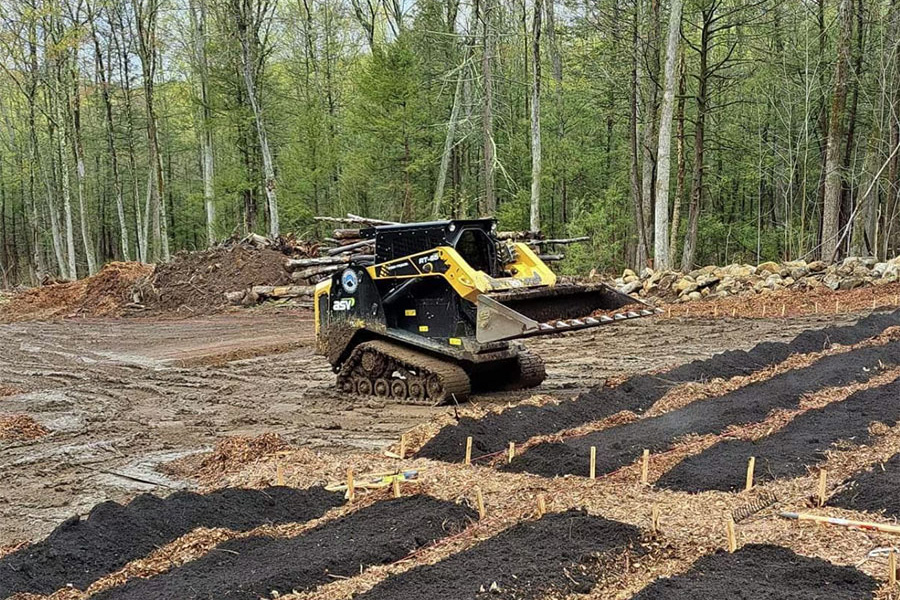
Forestry mulching is a selective, single-step land clearing method that turns standing vegetation directly into ground mulch. Using a specialized tractor or skid steer equipped with a high-powered mulching head (a rotating drum fitted with heavy teeth), trees, saplings, and heavy brush are shredded right where they stand.
How It Works:
-
Shredding: The mulcher grinds brush, invasive species, and small-to-medium trees from the top down.
-
Mulch Layering: The shredded organic material falls directly onto the ground, leaving a uniform 2-to-4-inch layer of wood chips.
-
Soil Preservation: Roots remain intact underground, and topsoil is left undisturbed.
Best Used For:
-
Underbrush & Invasive Species Removal: Clearing blackberry vines, brush, saplings, and overgrown fields.
-
Trail & Access Road Creation: Opening up paths through heavily wooded properties.
-
Pasture Maintenance & Firebreaks: Clearing land for agriculture, livestock grazing, or wildfire defense.
-
Erosion-Sensitive Slopes: Sites where stripping root systems would trigger soil runoff or mudslides during heavy rains.
Pros: Cost-effective and fast; requires no hauling or burning; the resulting mulch suppresses weeds and prevents soil erosion.
Cons: Leaves tree roots under the surface, making it unsuitable for immediate foundation digging; high mulch volume takes time to decompose.
The Verdict: Getting It Right the First Time
If you plan to pour concrete, dig footings, or lay down a gravel driveway in the immediate future, traditional land clearing is necessary to prevent ground settling as buried roots rot over time.
However, if your goal is to reclaim overgrown acreage, open up views, clear underbrush, or establish trails without disturbing the soil, forestry mulching offers a faster, eco-friendly, and cost-efficient solution.
Many large projects actually benefit from a hybrid approach—using traditional clearing for the specific building pad and driveway footprint, combined with forestry mulching across the surrounding acreage to keep the landscape clean and manageable.
Ready to Clear Your Property?
Contact Northwest Dirtworks today to schedule an on-site property evaluation and get a free estimate for your project.